I’ve known about Bill Siegle and his knives for at least a couple of decades now. We were both active back on the now-defunct Knife Forums back in the day. I’d always admired his work and have followed him on social media, but somehow never managed to pick anything up. That needed to change.
Getting to Know Bill Siegle Knives
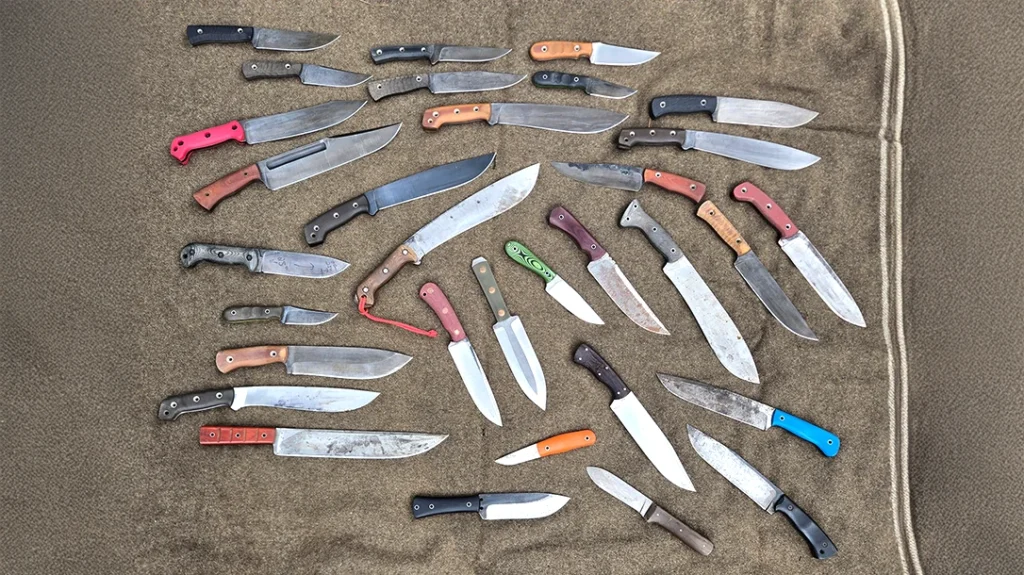
Fast forward to this past spring, and I finally got to meet him in person at Ethan Becker’s “Beckerhead Gathering” out in Montana. I had a chance to personally check out a number of his designs while I was there. Then, I arranged to get a couple for review once I got home.
Advertisement — Continue Reading Below
Bill’s Background
Bill has been making knives for a long time. He worked the family sawmill and was always around sharp stuff. Add in hearing stories about some family knives used camping, by relatives in the military. Mix that with a dash of Conan comics, and Bill was primed for an early start. He made his first knife when he was 8, and said his parents found out when he was 10 or 11.
Bill is about my age, in his mid-50s, so this was back in the dark ages before the internet. He was self-taught and basically scrambled to find knife-making info wherever he could. He said a lot of what he found was wrong. When he was 17, he met Mastersmith Jim Schmidt, who set him straight and on a path to becoming a serious knife maker.
Bill went on to serve four years in the Army as an 11B, infantryman. When he got out, he worked as an apprentice in a tool and die shop. After that company folded, he moved West with his wife and got a job at Benchmade Knives as a laser operator. He worked there for 11 years and continues to work around lasers, CNC equipment, and manual machines in his current day job.
Advertisement — Continue Reading Below

Keeping His Knives In House
Bill is a part-time maker but keeps as much as he can in-house and under his control. I asked him about his material choices. He told me he prefers simpler steels and primarily uses “locally sourced, organically fed, free range steels like 5160 and 1084.” I’m good with that, I like simple steels too. He will occasionally use some stainless steels, which he does send out for professional heat treating.
For handle materials, Bill works primarily with Micarta and G10. We talked a bit about prices, too. Since each piece is handmade and unique, prices vary but generally run in the $250 to $450 range. That can bump up or down a bit depending on the piece. He said that he remembers what it was like to need a good blade but be a broke soldier or teenager. So, he tries to keep his prices reasonable.
Advertisement — Continue Reading Below
The Test Blades
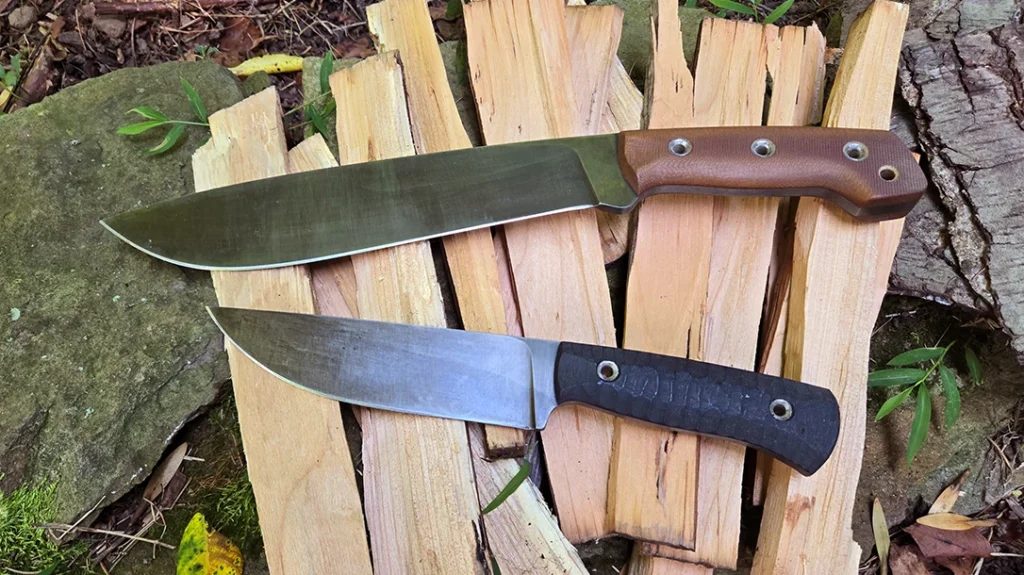
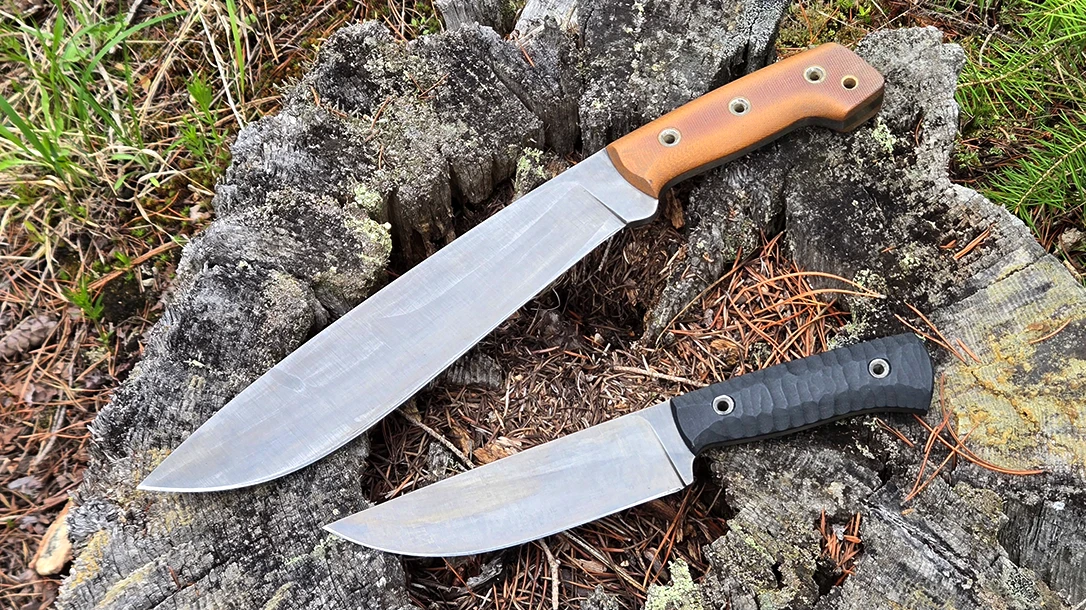
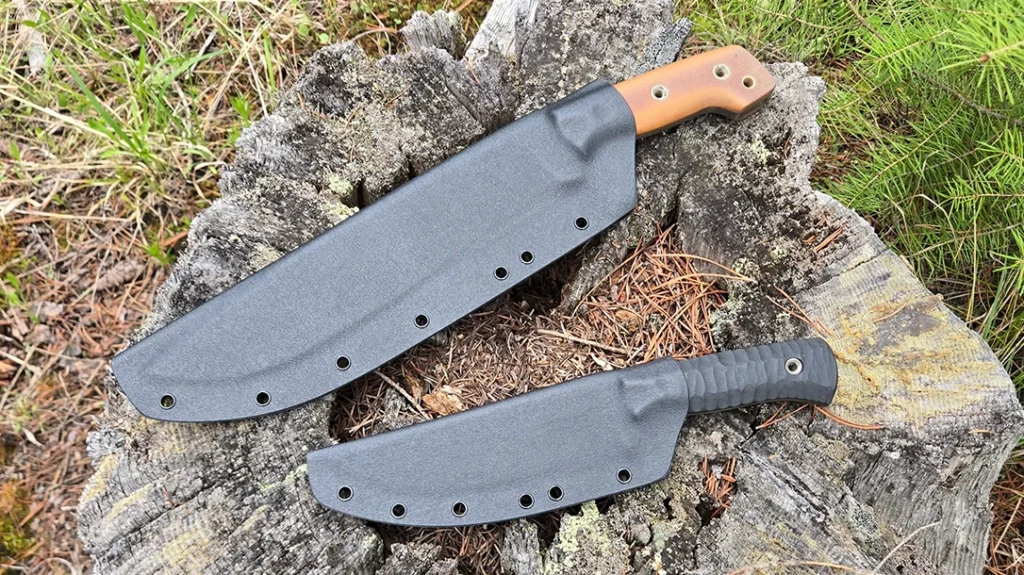
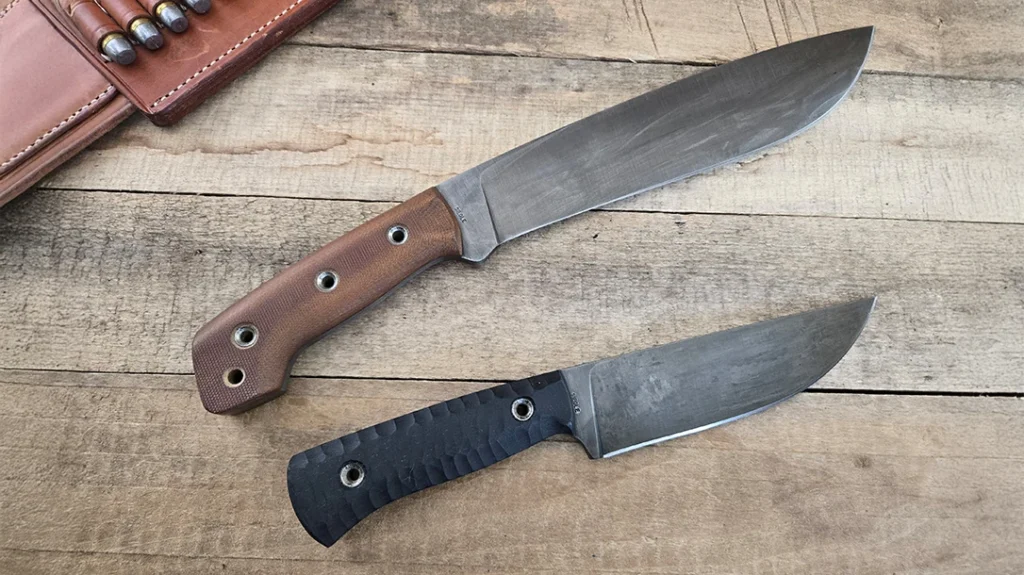
The two blades that I got for testing were a Skyhawk Bolo and a Camp Knife. Both knives are made from 5160 carbon steel using the stock removal method.
The Skyhawk has smooth scales in natural micarta. However, the Camp Knife has black G10 scales with scallops for extra grip. The finish is cold blued with a steel wool rub. In addition, both knives come with well-molded Kydex sheaths. They do not come with any clip or attachment, but the hole pattern will accept a Tek Lok, UtiliClip, or any attachment device of your choice.
Advertisement — Continue Reading Below
The Skyhawk Bolo currently runs $425, and the Camp Knife is $300, including shipping in the US.
The Skyhawk Bolo has a blade 10.25 inches long and is 15.25 inches overall. Bill based this on a bolo knife he saw a Vietnam War pilot carry, so it has neat lineage. The Skyhawk is a big knife, but not crazy large. It definitely falls into the camp chopper category.
Fit and finish are extremely good. The handles blend with the tang with no gaps or proud spots. The handle is 5 inches long and .75-inch thick. It’s big enough to give plenty of space for large hands or average-sized hands with work gloves on. You have enough space to choke back a bit when chopping, too, if you’re doing snap cuts.
Advertisement — Continue Reading Below
The Skyhawk Bolo In the Field
I primarily did heavier camp work with the Skyhawk. This included taking down some saplings out back that were encroaching on other plants. The 10-plus-inch blade and long handle made snap cuts efficient. Likewise, the slight inward curve to the design made it easy to find the sweet spot.
I was going through one to two-inch pieces in just a couple of hits, typically. For this type of chopping, I appreciate a smooth handle like the micarta one on the Bolo. There’s enough texture to the material to provide a solid grip for finer tasks, but it still lets your hand move with the blade during snap cuts.
Advertisement — Continue Reading Below
I did a bunch of batoning too. I know feelings are mixed on batoning, but I do like using it to make kindling for fires. Especially if the wood is wet and I want to get to the drier stuff on the inside. As long as it’s done judiciously and you aren’t trying to split anything crazy, it works well.
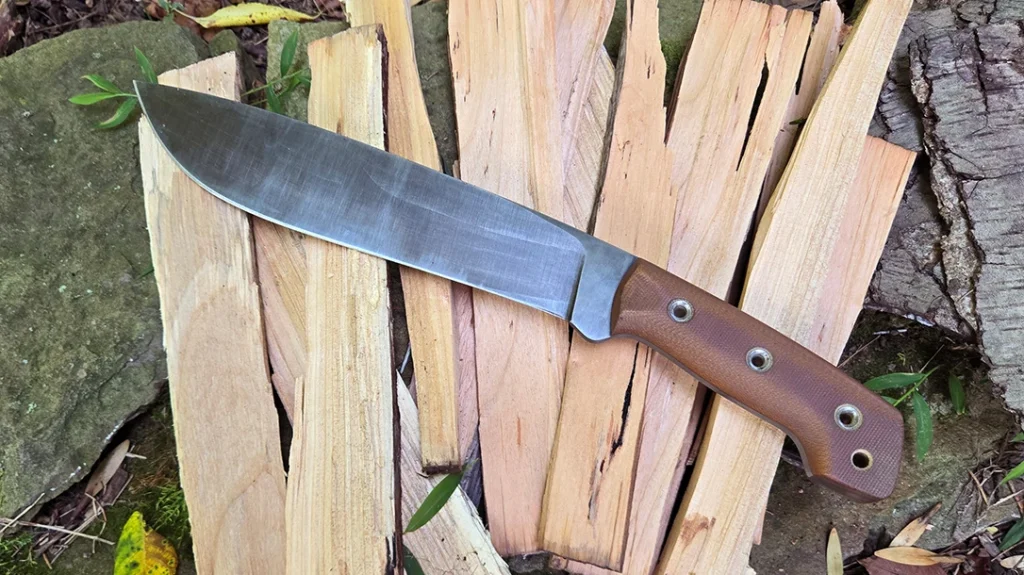
Either way, the Skyhawk handled it with ease. I checked the edge afterwards, and it was free of any sort of chips or rolls. That’s a testament to good heat treat.
Advertisement — Continue Reading Below
The Camp Knife In the Field
The Camp Knife reminded me a lot of an old trade knife. I mentioned that to Bill, and he agreed. It’s a simple, practical belt knife meant as a general-purpose, do-all tool. Our nation was built by folks carrying simple trade knives, and Bill just makes a better one.
The Camp Knife has a 6.5-inch blade and is 11.25 inches overall. The 5160 blade is .1875 inch thick, making it a fair bit tougher than the typical thin trade knife. Not that those didn’t do the job, but you’ve got some extra beef on the Camp Knife.
The handle scales on the Camp Knife have scallops for an improved grip. They’re comfortable in hand, and the scallops don’t have any sharp edges to cause hot spots or discomfort. They let your hand really lock onto the handle, with or without gloves.
Advertisement — Continue Reading Below
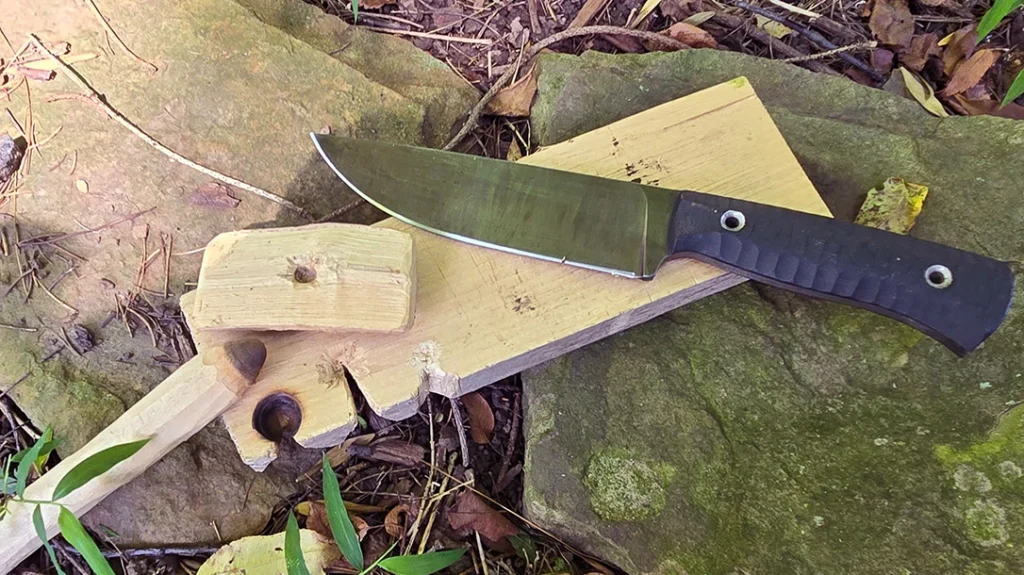
I did a bit more fine work with the Campo Knife than with the Bolo. I did some whittling, carved some stakes, and worked on my old fire board. The edge was excellent, and I was able to get good control when making notches. It’s still big enough to do some chopping too, and held up fine to some batoning as well.
Bill Siegle Knives: Practical Working Designs
I was always drawn to Bill’s designs with their clean lines and practical designs. They aren’t fancy, and there are no gimmicks. They’re solid working blades, often with the design rooted in history. Now that I’ve finally gotten my hands on some of his work, I can see that the fit and finish, balance, and edge quality are all there as well.
I can appreciate art knives for what they are, but I’d rather have a functional tool that I’ll use. I had a discussion at Blade Show with a collector a couple of years back. He commented that if he cut something with a collector’s knife, he would ruin its value. I laughed and commented that if I can’t cut something with a knife, then it has no value to me.
After spending the summer with a couple of Bill’s knives, I can definitely say that Siegle Knives absolutely have value. They’re handcrafted tools that are meant to be carried and used, not just put on a shelf for display.
The best way to contact Bill Siegle is on Instagram or on BladeForums.