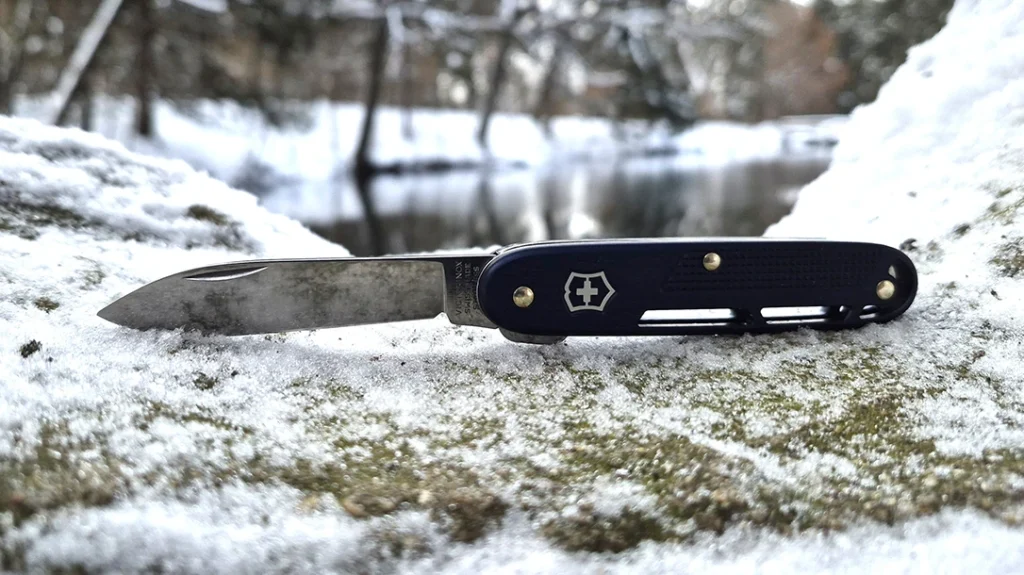
One defining feature of most modern folding knives is that they can be manually opened with only one hand. Studs, blade holes, and disks are so commonplace today that people take them for granted. However, that wasn’t always the case. So, what is the history of thumb openers? Let’s dig into it.
The History of Thumb Openers
I first started carrying a pocketknife in the early 1970’s when I was about nine. Back then, it was a Case slipjoint, and I carried it purely for utilitarian purposes. When I was 13 and started studying the martial arts, I got my first introduction to “knife fighting.”
I quickly upgraded to a Gerber Folding Sportsman II lockback, but I wasn’t sure how to open it quickly if I needed it. Back then, the most popular knives—like Buck Knives’ 110 and 112 and Gerber’s FS series—still had traditional nail nicks. As such, they were, by design, two-hand openers.
Advertisement — Continue Reading Below
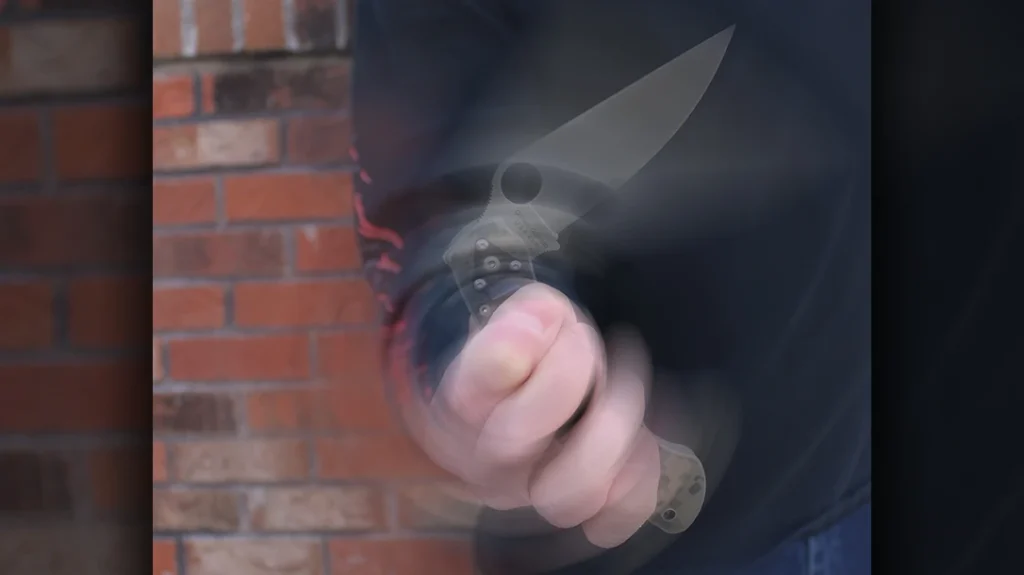
Although some guys had figured out how to grip the blade and swing the handle to open them, there were no purpose-designed thumb-opening knives.
One day, one of my training partners showed me his knives, which all had attachments on the blade spine. He also handed me a copy of Soldier of Fortune magazine and suggested I check out the ads in the back.
DIY Thumb Openers
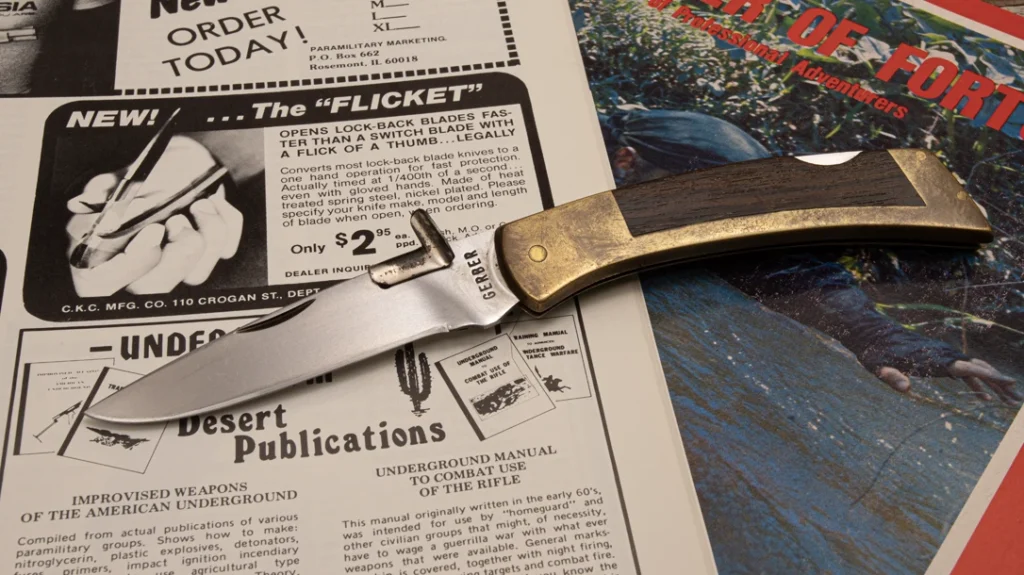
In those ads, I found advertisements for the “Flicket,” a clever device made of bent steel. You slipped it on the spine of your folder and tapped it into place to provide a thumb purchase. Available in several sizes to fit your blade thickness, it offered excellent leverage for a lightning-quick thumb opening.
Advertisement — Continue Reading Below
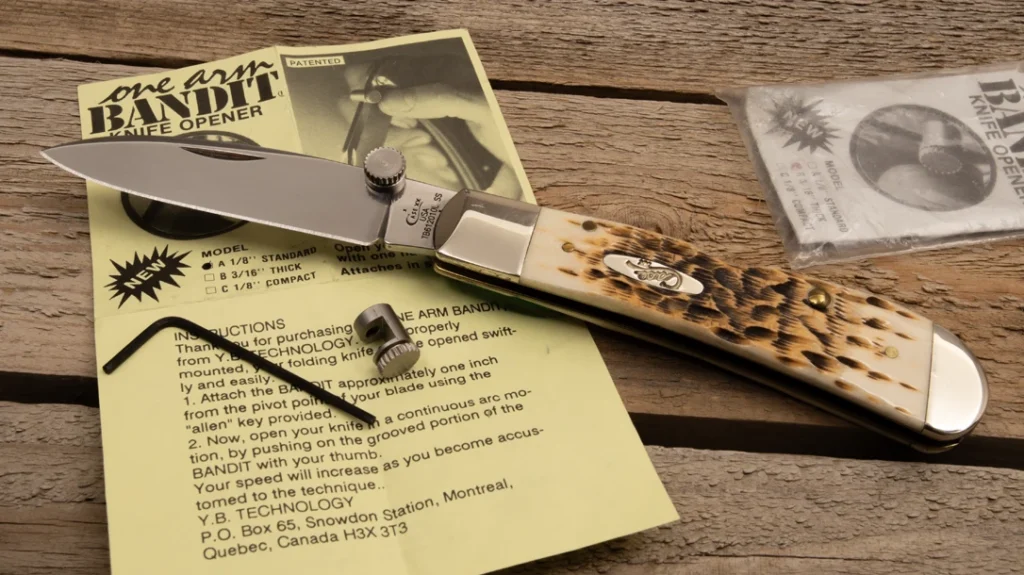
I also discovered the “One Arm Bandit.” It is a machined attachment that is mounted to the blade spine with set-screw tension. Once attached, it resembled a modern thumb stud and offered a purchase for right- or left-hand thumb openings.
Advertisement — Continue Reading Below
Ultimately, I ordered and tried both products but settled on the Flicket for my Gerber FS II. That combination served me well into the early 1980’s. It also got me wondering why no knifemaker or manufacturer had incorporated a purpose-designed thumb opener into a knife. As it turns out, they had.
Paul Fox
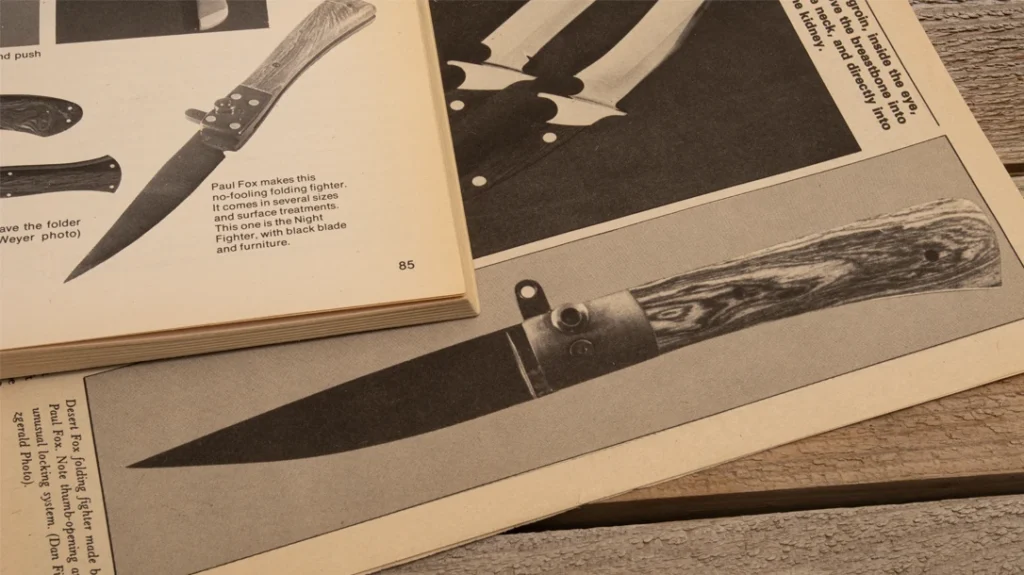
Jess Paul Fox Jr., better known as Paul Fox, was a custom knifemaker from North Carolina. He made his first knife in 1977 and soon developed a unique style all his own. One of his signature features was an integral lever on the spine of the blade.
Often checkered to ensure a non-slip surface, it provided an ultra-quick thumb opening—just like a Flicket. However, it did that as an integral feature of the knife and did it years before factory knives did.
Advertisement — Continue Reading Below
I first saw Paul’s Desert Fox and other designs in magazine articles by pioneering knife writer David E. Steele and Knives ’81. Years later, I had the privilege of handling one of his exquisitely crafted custom folders and trying the thumb opener. As I expected, it worked like a charm. It also validated my belief that it was an idea that had been way ahead of its time. As it turns out, it wasn’t.
The Roll-X
I have always been fascinated by all types of one-handed-opening knives. To feed that habit, I often scour websites and forums devoted to classic switchblades. Not long ago, I saw a listing on one of those sites for a knife called the Roll-X.
Advertisement — Continue Reading Below
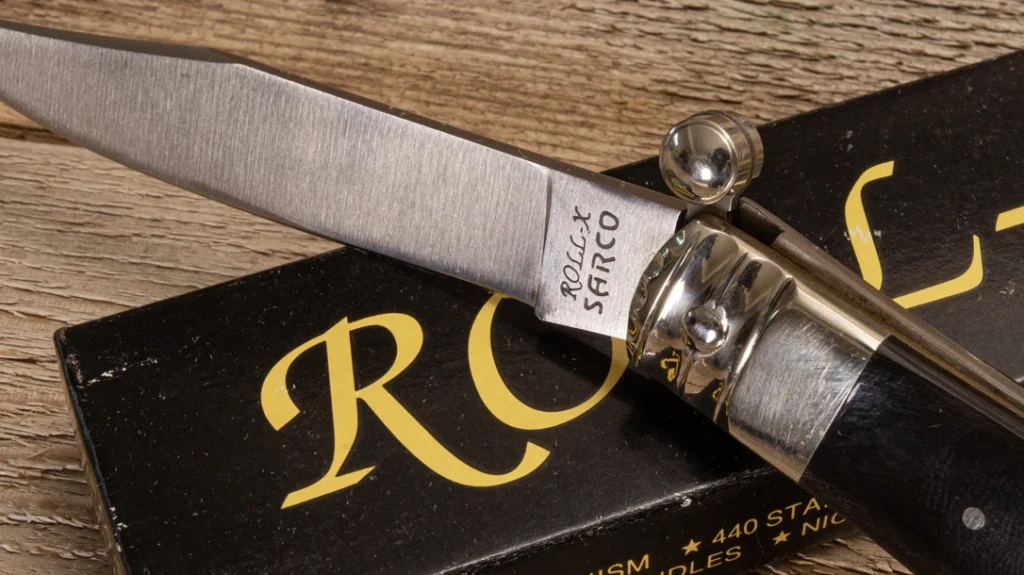
According to the site, the knife was manufactured by Tak Fukuta in Seki City, Japan, for Sarco/Edge Company sometime in the 1980s. Its design and “Roll-Over” mechanism, however, were supposedly based on an earlier model called the “Rapid,” which “had its origins in Italy in the 1960’s.” That piqued my curiosity, so I immediately added a Roll-X to my collection.
The Roll-X was a beautifully made knife for its time, featuring brass liners, nickel silver bolsters, and a 440C stainless steel blade. Its most unique feature, however, is a ball-shaped lever attached to the spine of the blade. Thumb pressure on the ball opens the blade swiftly with only one hand, just like Paul Fox’s integral lever.
Advertisement — Continue Reading Below
However, the Roll-X thumb lever also does double duty. When the blade is open, a spring-loaded bar with a lug drops into a notch in the tang, locking it. Pushing the thumb lever forward raises the spring-loaded bar and unlocks the blade, similar to a scale-release style of back lock.
The Roll-X was made with both dark-horn and white-bone scales. Although some listings I found for it claimed earlier dates of manufacture, all confirmed that it was inspired by the earlier Rapid design. As such, that was the next step in my quest.
The Rapid
The first specific reference I saw to the Rapid was a listing of a knife for sale on AllAboutPocketknives.com. It claimed that it was made in the 1960’s after the Federal Switchblade Act of 1958 was passed.
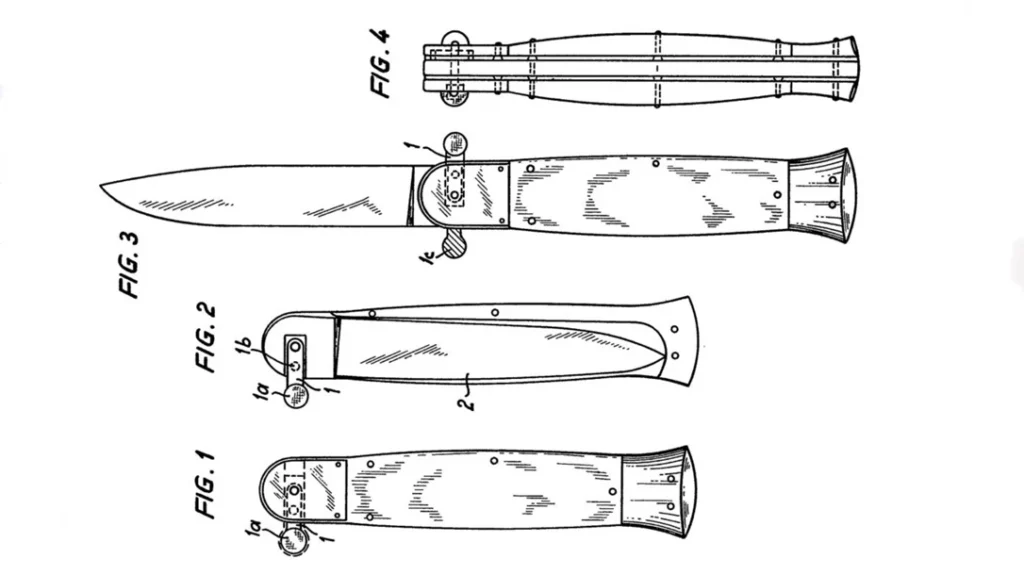
Manufactured in Italy, it was intended as a legal one-hand-opening alternative to a switchblade. The design was made with both single and double “balls” for the opening lever.
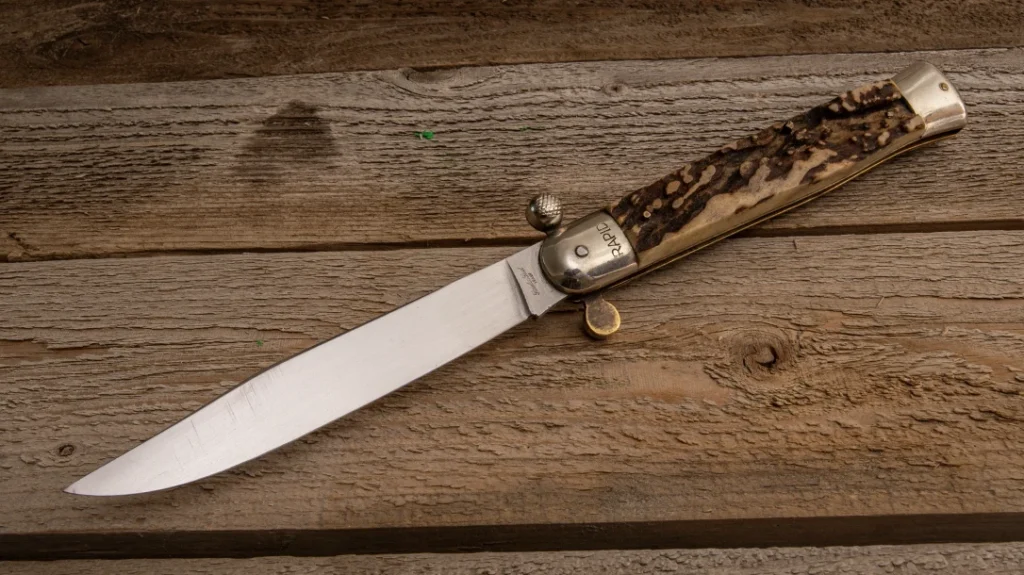
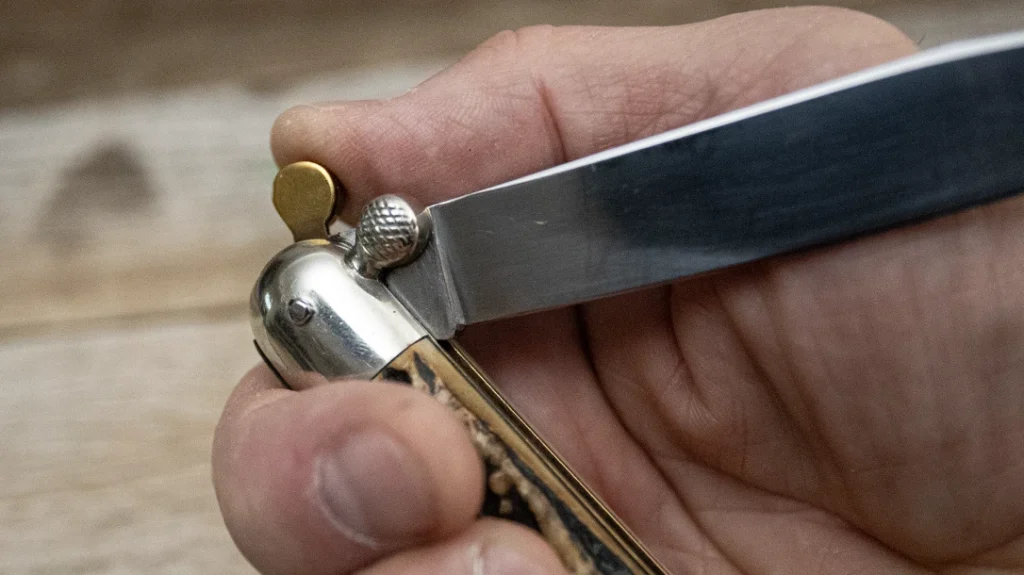
In single-ball knives, the entire ball/lever traveled with the blade. In double-ball versions, the reverse half of the lever was integral to the liner. The obverse half served as the lever and traveled with the blade. When open, the opposing balls looked like a double guard. Some expressions of the design locked, while some did not. Similarly, some were marked “RAPID” on the bolster, and others were supposedly not.
After several failed attempts to purchase a single-ball Rapid, I managed to buy a non-locking double-ball version. Proudly stamped “RAPID” on the bolster, it is also marked “Stainless Steel Italy” on the blade. Although its riveted construction is comparable to an old-school Italian switchblade, it boasts beautiful, genuine stag scales. Best of all, its thumb-opening function is as swift and positive as any modern tactical folder.
The website listing referenced earlier also mentioned a “mistaken” belief that the Rapid had been made in Germany. Despite the author’s denial, more research revealed that the Rapid’s thumb-lever mechanism had indeed been patented by two German inventors.
In 1965, Günther Scheel and Hans Zissener applied for patents in Switzerland and the U.K. Both were granted in 1966 and 1967, respectively. Curiously, I could find no evidence that a Rapid-style knife had ever been manufactured in either country. However, digging even deeper took me back to Germany and even further back in time.
The German Rapid
According to the book German Tool & Blade Makers: 1850-2000 Trademark Guide, the mark “Rapid” was associated with “Ernst Scharff, Kober & Co., Frankfurt am Main and Leipzig.” That company was in operation circa 1932.
In a post on the AllAboutPocketknives forum, a forumite shared a purchase he’d made in 2019. He described it as a “Rapid Rolling Lock knife made in Germany in the 1930’s.” Its blade markings were “PAT. ANG. SZL Rostfrei.”
“PAT. ANG” is short for the German “Patent angemeldet,” which translates as “patent pending.”
“Rostfrei” means “stainless steel,” leaving “SZL” as an abbreviation of the likely manufacturer.
Extensive searching has revealed several other folding knives marked “SZL,” but no hard information on the manufacturer…yet. Nevertheless, there seems to be strong evidence that the Rapid and the thumb-opening folder had roots in Germany as early as the 1930’s.
Thumb Openers Have a Long, Storied History
Manual one-hand-opening folding knives really “came of age” in the early 1980’s. Spyderco founder Sal Glesser pioneered the now-iconic “Trademark Round Hole” in 1981. Bob Terzuola, the “Godfather of the Tactical Knife,” began using a disk-style thumb purchase on his folders in the mid 80’s.
Around that same time, other custom makers and a few manufacturers began incorporating thumb studs on their designs. By the end of that decade, thumb openers were commonplace.
While these makers were certainly instrumental in popularizing the purpose-designed thumb-opening folder, they were not the first to conceive the concept or render it in steel. The variations of the Rapid folder alone suggest that innovation happened at least 50 years earlier. Though its form might have been somewhat different, the speed and convenience it offered were undeniably the same.