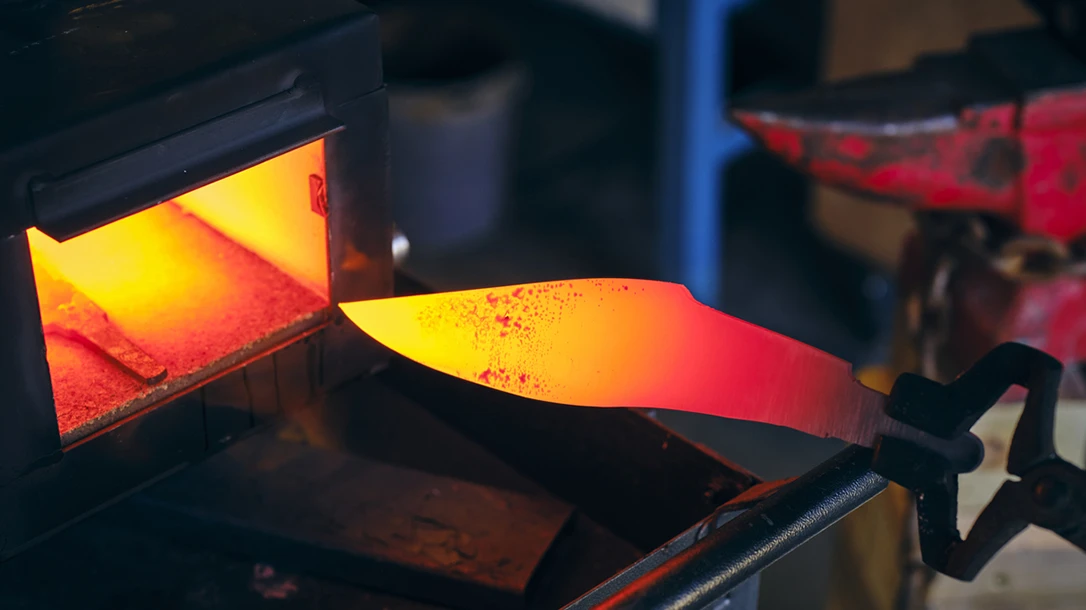
Not all knives are created equal. A crucial determining factor in a knife’s construction that makes it unique is the steel it is made of. Assuming the heat treat is done properly, the steel itself determines factors such as purpose, performance, edge retention, durability, cost/value, etc.
Knife Steels and Their Factors
Hardness
Hardness refers to a steel’s ability to resist microscopic distortion and is measured on the Rockwell scale. In simple terms, harder steels hold an edge longer, but that edge-holding performance comes at the expense of toughness. Softer steels, on the other hand, give up edge retention more quickly but are generally better at absorbing abuse.
More hardness doesn’t automatically mean better knife steel. Push hardness too far, and the blade can become brittle, increasing the risk of chipping or catastrophic failure. For most knives, a Rockwell hardness in the 58–60 range strikes a solid balance, though some modern steels can safely stretch that number to around 62 without sacrificing reliability.
Advertisement — Continue Reading Below
Toughness
Toughness is a blade steel’s resistance to chipping, cracking, or outright breakage when subjected to stress or impact. This quality is commonly evaluated through bend tests, fracture tests, and impact testing.
When toughness fails, the result is often a broken blade—something that’s not just inconvenient but potentially dangerous. These failures usually trace back to poor steel choice, improper heat treatment, or improper grinding discipline. Unlike normal wear-related edge degradation, toughness failures tend to result in catastrophic breakage.
Wear Resistance
Wear resistance is exactly what it sounds like: a steel’s ability to resist material loss over time as it contacts other materials. This property is influenced by both hardness and the steel’s chemical properties. Knife wear generally falls into two categories: abrasive and adhesive.
Advertisement — Continue Reading Below
Abrasive wear occurs when the edge is slowly eroded or rounded off by abrasive materials like sand, sandpaper, and various other slurries and powders.
Adhesive wear happens when two relatively smooth surfaces interact—steel on steel, carbide on steel, and similar combinations. Sharpening is actually a controlled form of adhesive wear, where material is intentionally removed through friction and pressure.
When reviewers slice through cardboard or other tough materials, they’re not just creating dramatic photos. They’re demonstrating how well a blade resists wear in subject matter that is notoriously hard on an edge.
Advertisement — Continue Reading Below
Corrosion Resistance
Corrosion resistance describes a steel’s ability to withstand moisture, humidity, and corrosive environments like saltwater. This resistance is primarily achieved through alloying elements, most notably chromium. The more effectively a steel resists oxidation, the less maintenance it demands in harsh conditions.
Premium Steels
Magnacut
CPM MagnaCut was engineered specifically for knives, delivering a rare balance of toughness, edge retention, and true stainless corrosion resistance. Designed by Dr. Larrin Thomas, it can be hardened into the low to mid 60s HRC without becoming brittle, making it equally suited for hard-use blades and refined everyday carry knives where reliability matters.
CPM-S90V
Often viewed as a modern successor to 440C, CPM-S90V is a martensitic stainless steel enhanced with vanadium and carbon for exceptional wear resistance. It significantly outperforms 440C and D2 in edge longevity while offering corrosion resistance that meets—or exceeds—440C.
Advertisement — Continue Reading Below
M390
Frequently labeled a “super steel,” M390 is a third-generation powder metallurgy stainless steel from Böhler-Uddeholm. Its impressive corrosion resistance rivals H1, while the blend of chromium, molybdenum, vanadium, and tungsten allows for high hardness and outstanding edge retention. The tradeoff is sharpening difficulty, but the payoff is far fewer sharpening sessions overall.
Elmax
Another Böhler-Uddeholm offering, Elmax combines high chromium, vanadium, and molybdenum content to deliver both wear resistance and corrosion resistance, which are two traits that don’t always coexist. Produced via powder metallurgy, Elmax grinds easily for makers and rewards users with strong edge retention. Despite being stainless, it sharpens more like carbon steel.
CTS-XHP
Comparable to D2 but refined through powder metallurgy, CTS-XHP slightly outperforms D2 in edge retention while offering improved corrosion resistance. Like D2, it takes more effort to sharpen, but the performance gains often justify the work.
Advertisement — Continue Reading Below
CPM-M4
A high-carbon tool steel built for toughness and edge retention, CPM-M4 is made using Crucible’s CPM (Crucible Particle Metallurgy) process. The “M” denotes high molybdenum content, supported by vanadium, tungsten, and ample carbon. Capable of reaching 62–64 HRC, M4 excels under hard use but is prone to corrosion and not especially easy to sharpen.
CPM-S35VN
Developed in collaboration with Chris Reeve, CPM-S35VN improves on S30V with a finer grain structure and the addition of small quantities of niobium. The result is better toughness, easier machining, and improved sharpening characteristics, making it a favorite among both makers and users.
H1
Purpose-built for wet environments, H1 is precipitation-hardened (PH) and contains nitrogen, making it virtually rust-proof. A unique quality of PH steel, like H1, is that it is naturally hardened without heat treatment. While edge retention and wear resistance aren’t its strong suit, it excels in diving and marine applications.
Advertisement — Continue Reading Below
High End
154CM
Often considered as an upgraded 440C, 154CM incorporates molybdenum to enhance edge retention while maintaining strong corrosion resistance. With proper sharpening equipment, it’s relatively easy to maintain.
CPM-154
The powder metallurgy version of 154CM, CPM-154 benefits from finer carbides, resulting in slightly better toughness and edge retention.
CPM-3V
Designed for extreme toughness and wear resistance, CPM-3V excels in situations where chipping or breakage is a concern. It holds an edge well but is harder to sharpen. Its impact resistance makes it a solid choice for bushcraft tasks involving batoning or chopping.
CPM-4V
Similar to 3V but with slightly less toughness and better edge retention, CPM-4V offers solid impact resistance with very good wear resistance. While 3V edges it out in corrosion resistance, 4V holds an edge longer.
CPM-S30V
A true stainless steel developed by Dick Barber of Crucible Industries, with input from Chris Reeve, CPM-S30V is known for corrosion resistance and a refined grain structure thanks to vanadium carbides. As a result, knives made from this steel deliver improved sharpness and toughness. It can be challenging to heat treat, but makers appreciate how easily it grinds compared to other powder steels.
Nitro-V
Based on AEB-L and enhanced with nitrogen and vanadium, Nitro-V delivers improved toughness, hardness, and corrosion resistance. It excels in thin blade stock applications, such as kitchen knives, razors, and compact folders, where a keen, stable edge is critical. Easy sharpening and excellent edge stability make it a crowd favorite.
AEB-L
Widely used in razor blades, AEB-L forms small carbides that provide excellent edge retention while remaining easier to sharpen than most stainless steels. Its fine grain structure, edge retention, and toughness also make it a strong candidate for bushcraft use.
Mid-Range
1095 HC
A classic high-carbon steel prized for affordability and performance, 1095 offers strong wear resistance and edge retention, and is easy to sharpen in the field. Its brittleness often necessitates thicker blade stock, making it more common in fixed blades. High carbon content means it is prone to rust and corrosion. For this reason, most knives using 1095 feature some form of coating to protect the steel. However, the edge is still exposed, so diligent rust prevention is essential.
5160 HC
Similar to 1095 but slightly tougher due to lower carbon and added alloying elements, 5160 offers marginally better corrosion resistance. However, it still requires regular maintenance, and you will want to keep the edge oiled.
154CM
Considered an upgraded version of 440C, 154CM continues to shine as a balanced stainless steel, offering toughness, hardness, and corrosion resistance. Capable of reaching 58–61 HRC, it delivers solid edge retention, making it excellent for outdoor knives. CPM-154 is the premium powder version of 154CM.
D2
An air-hardening, high-carbon tool steel, D2 is known for excellent wear resistance, abrasion resistance, and edge longevity. Capable of being hardened to 55-62 HRC, it can be machined in the annealed condition. Its high chromium content provides mild corrosion resistance, but care and maintenance are still necessary.
A2
With less chromium than D2, A2 trades some wear resistance for easier machining, good toughness, medium wear resistance, and decent edge retention. It offers reliable hardness and dimensional stability, making it a dependable all-around tool steel. An air-hardening steel, A2 offers hardness of 57-62 HRC.
O1
A forgiving low-alloy steel with excellent toughness and wear resistance, O1 holds an edge well and sharpens easily. Like most high-carbon steels, it requires protection from rust.
VG-10
Popular in kitchen knives, VG-10 is a high-carbon stainless steel that resists corrosion and holds a sharp edge, but can be prone to chipping due to its hardness. This makes it less suitable for heavy outdoor or bushcraft use.
AUS-8
Comparable to 440C, 154CM, and D2, AUS-8 is a stainless steel that balances hardness, toughness, wear resistance, and corrosion resistance. It sharpens easily while maintaining respectable edge retention.
N690
An Austrian stainless steel similar to 440C but capable of higher hardness, N690 maintains good wear resistance. Likewise, it benefits from the addition of 1.5% cobalt, which enhances edge quality and sharpening ease.
8Cr13MoV
Common in budget-friendly EDC knives, Chinese-made 8Cr13MoV is tough, corrosion-resistant, and easy to sharpen. While edge retention is modest, its overall performance punches above its price point.
420HC
Softer and tougher than many 440-series steels, 420HC is easy to sharpen and highly corrosion-resistant. Its rugged nature makes it well-suited for outdoor and utility applications where reliability matters more than extreme edge retention. It provides greater strength, hardness, and wear resistance than most 400-series grades.
Low End
AUS-8
AUS-8 is a practical, no-nonsense stainless steel that balances toughness, corrosion resistance, and ease of sharpening. It won’t chase extreme edge retention, but it delivers reliable, real-world performance where consistency and usability matter most.
400 Series
The 400 Series favors corrosion resistance, toughness, and easy maintenance over extreme edge life. Steels like 420 and 440 excel in hard-use, wet environments where reliability and quick sharpening matter most.
Sandvik Series
Sandvik steels emphasize fine-grain structure, corrosion resistance, and easy sharpening. While not built for extreme edge retention, it delivers consistent, stable performance ideal for everyday carry and outdoor use.