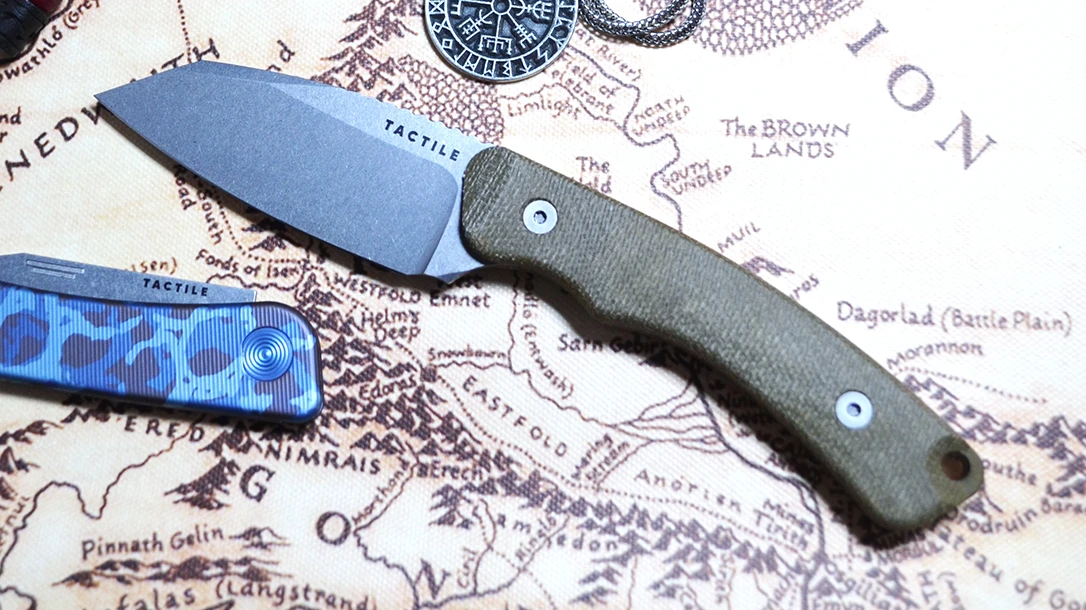
I’m kind of upset with Taylor Martin. Don’t get me wrong, the host of the Best Damn EDC channel on YouTube knows his stuff when it comes to knives and other gear. He’s affable and charming. By all accounts, he’s a pretty decent guy all around. But his collaboration with Tactile Knife on the Redhawk is the knife I wish I had designed.
The Tactile Knife Redhawk Collaboration
See, I had planned to design a killer EDC knife, one that’s well-balanced, practical, and ergonomic. Never mind the fact that I’d not put pencil to paper and so much as scribbled any sort of sketch. I had the notion of a plan, okay? But he beat me to it. The Redhawk is one of the best EDC fixed blades I’ve ever run across.
Advertisement — Continue Reading Below
Martin collaborated with Tactile Knife Co. to manufacture the Redhawk. This was a great decision, as they have a stellar reputation for high-quality knives. Everything they produce comes from their shop in Dallas, Texas. That’s where the knives are machined, assembled, and shipped. They don’t farm anything out overseas.
I’ve been using their Bexar folding knife for a few months now, and it’s excellent. So, I knew going in that the Redhawk wasn’t likely to be a dud.
What’s So Great About the Redhawk?
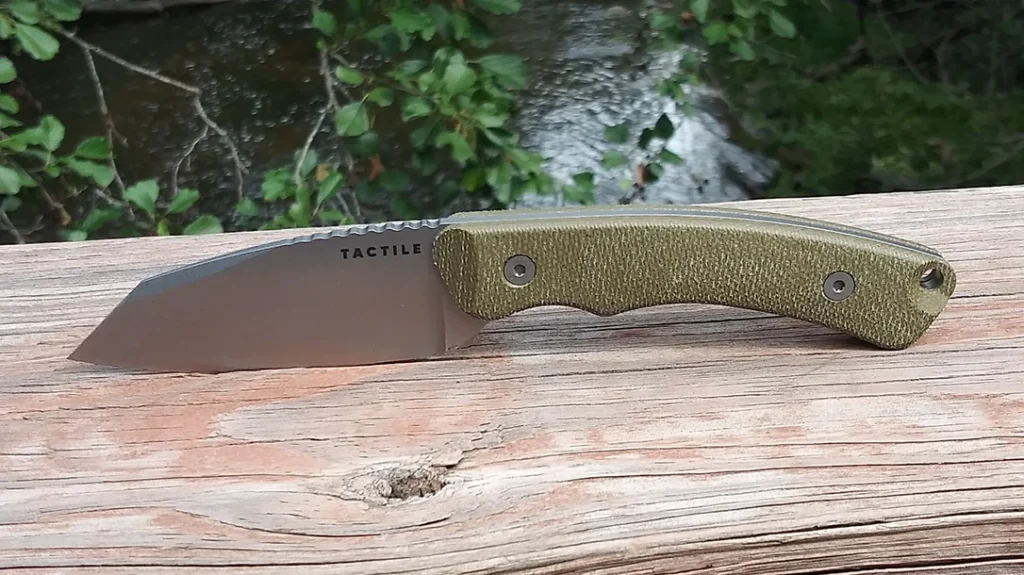
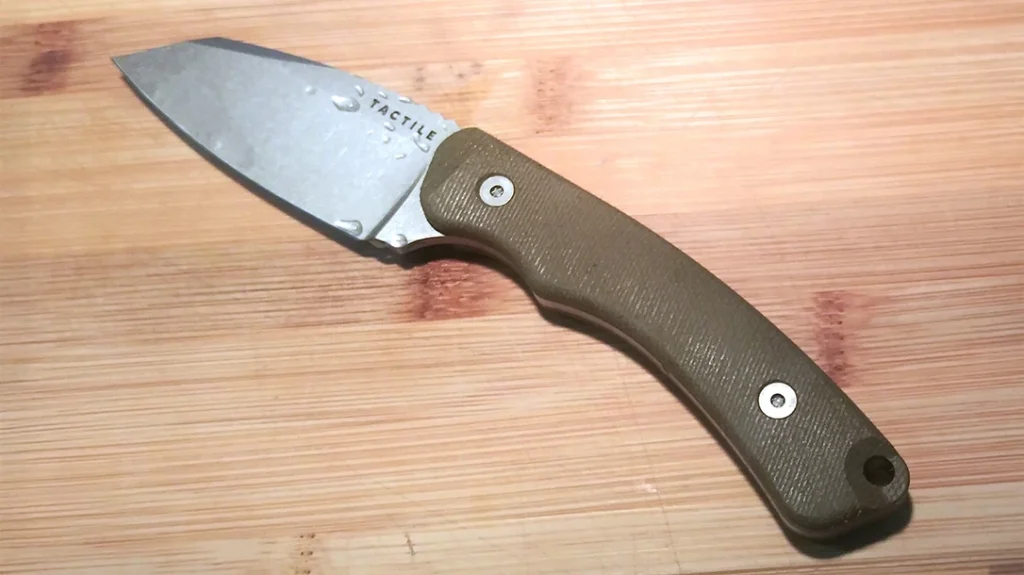
Let’s start with the handle. It’s a hair over four inches long. This allows plenty of real estate for a full, confident grip. None of that three-finger grip nonsense. The Micarta scales are textured to allow for a secure grip. Between that and the finger choil, the knife never feels awkward or clumsy. It really locks into your hand.
Advertisement — Continue Reading Below
Just behind the blade, the handle features small scallops that allow for a decent pinch grip. While not unique, this is a detail many EDC knives lack.
Combined with a 2.75-inch blade, you have an overall length of just under seven inches. That’s a comfortable carry size. Tipping the scales at just over three ounces, it isn’t going to weigh down your pocket, either.
Advertisement — Continue Reading Below
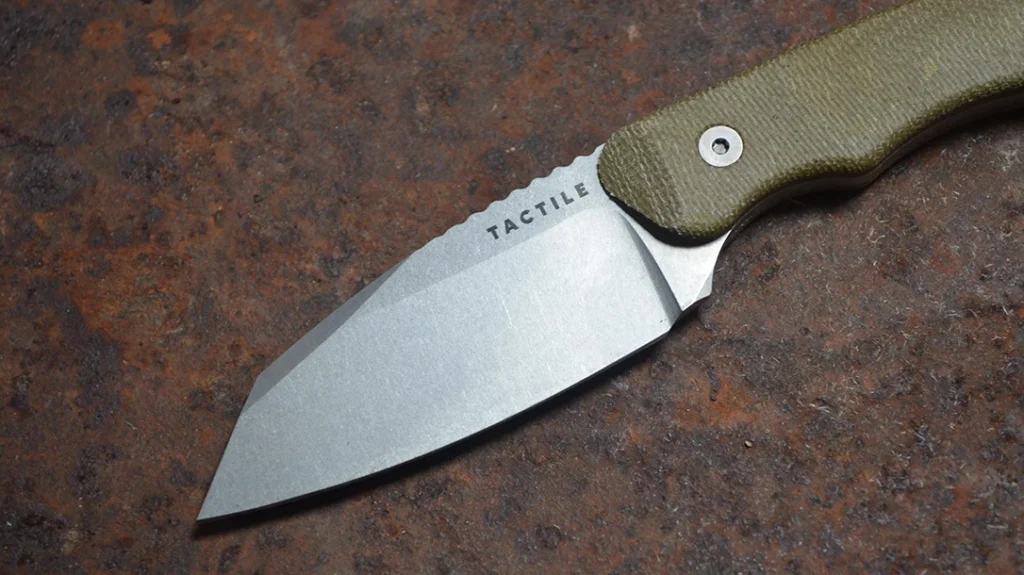
The MagnaCut blade has a reverse tanto profile. The reverse tanto is sort of a kissing cousin to the Wharncliffe and sheepsfoot profiles. Here’s how to tell the difference between the three. The Wharncliffe’s spine has a long, gradual taper down to the tip. The sheepsfoot’s spine has a steeper, more immediate turn downward, though it’s still rounded. In contrast, the reverse tanto is more angular, resulting in a strong tip suitable for heavier work.
At the spine, it’s 0.120-inch thick. The jimping isn’t overly aggressive, which is always appreciated. The knife has a distinct curve along the back from the tip to the end of the handle. What this does is put the blade’s edge exactly where you want it when you have the knife in your hand, allowing for great leverage with little effort.
Carrying the Redhawk
The Redhawk comes with either a Kydex or leather sheath. Mine is Kydex, and it’s very well-made. The knife is held securely without any rattle at all. There is a convenient thumb break built in to allow for easy deployment.
Advertisement — Continue Reading Below
The sheath has a Discreet Carry Concepts pocket clip, which can be easily removed if that’s your preference. If I’m using a pocket-carry fixed blade, I don’t usually clip it to my pocket. I just drop it entirely into the pocket. The clip here works very well at keeping the knife in place, though, if that’s your preferred carry method.
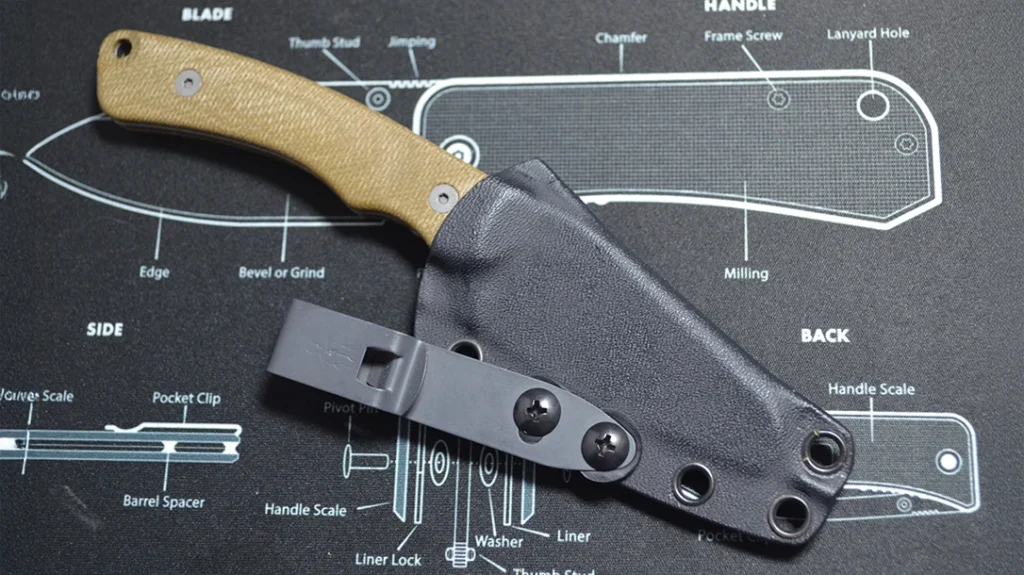
At press time, the leather sheath option is sold out, but I’ll be looking for it when they have a restock. I’ll admit to being something of a traditionalist when it comes to sheaths and prefer leather over other materials. Again, though, that’s just a personal preference.
Advertisement — Continue Reading Below
The Redhawk is available in a few different configurations. Mine is the base model, with a tumbled blade finish and green micarta scales. It also comes with a green Cerakote blade and natural canvas micarta scales or black Cerakote with dark black canvas micarta, with each of those iterations priced slightly higher than the standard.
Yeah, Okay, But Does It Cut?
I own and have used a ridiculous number of knives. Seriously, far more than the average person would ever need in several lifetimes. While I know that doesn’t make me unique among readers of Tactical Knives, I tell you that to tell you this:
I’m quite impressed with the Redhawk. It is an incredibly well-designed and well-built knife, and it’s quickly become one of my favorite options in my EDC rotation.
Advertisement — Continue Reading Below
I carried the Redhawk routinely for a few weeks, using it whenever and wherever I could. It did everything from trimming a few loose threads on a shirt to cutting duct tape to cutting cubes of cheese for my granddaughter. It performed admirably with every task put before it.
Then, for the purposes of this review, I put it through a few actual tests.
Putting the Redhawk to Work
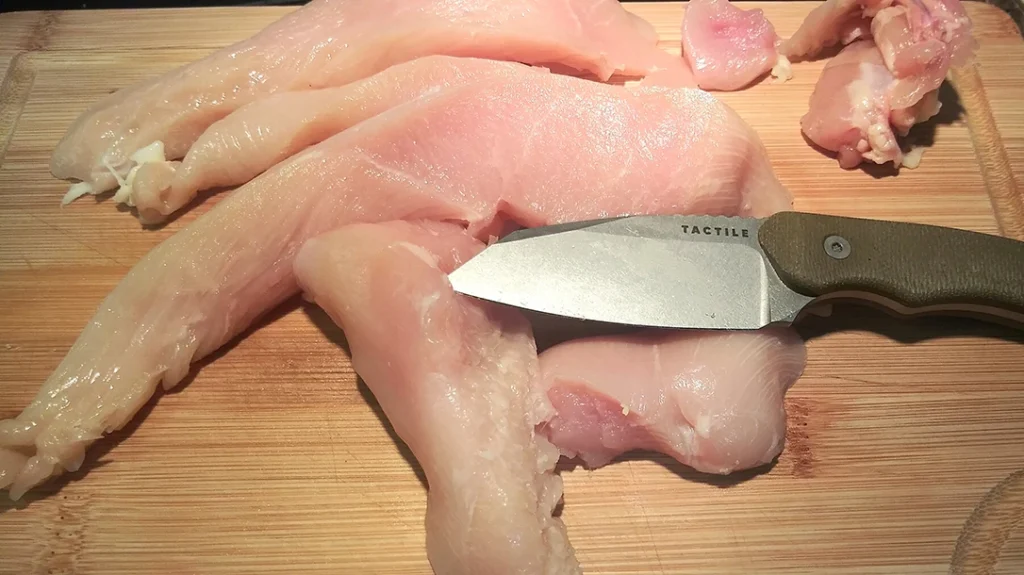
First up was kitchen detail. My wife had a rough day yesterday, so for dinner I made one of her favorites. She loves my homemade chicken fingers with mashed potatoes and country gravy. I used the Redhawk to chunk the potatoes, and it worked fine.
Advertisement — Continue Reading Below
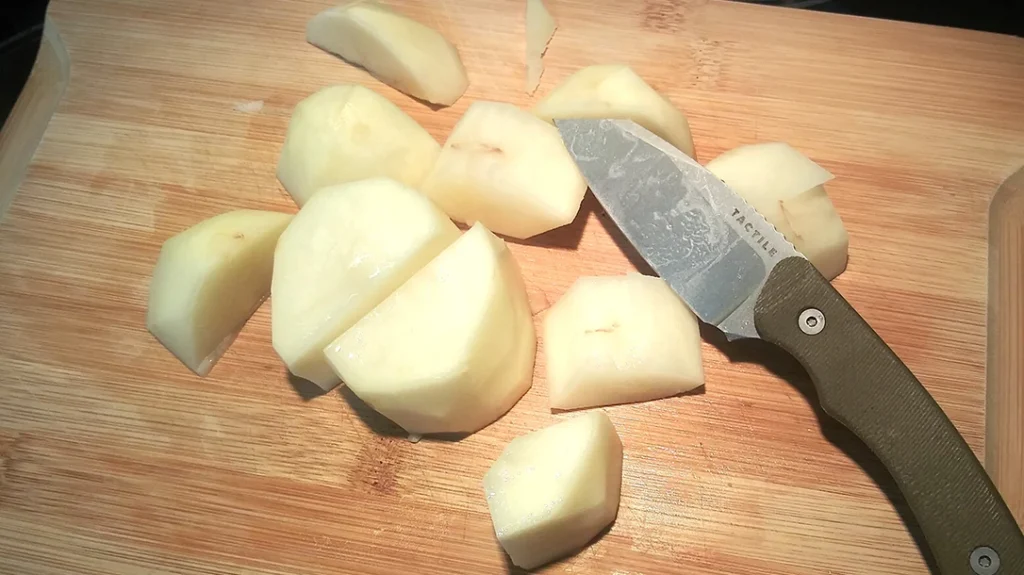
The blade is a bit thicker than a standard kitchen knife, but it was definitely workable. There were no issues at all with the chicken breasts. Trimming and slicing were simple and easy. Remember, always slice the chicken across the grain, as it turns out more tender that way.
Advertisement — Continue Reading Below
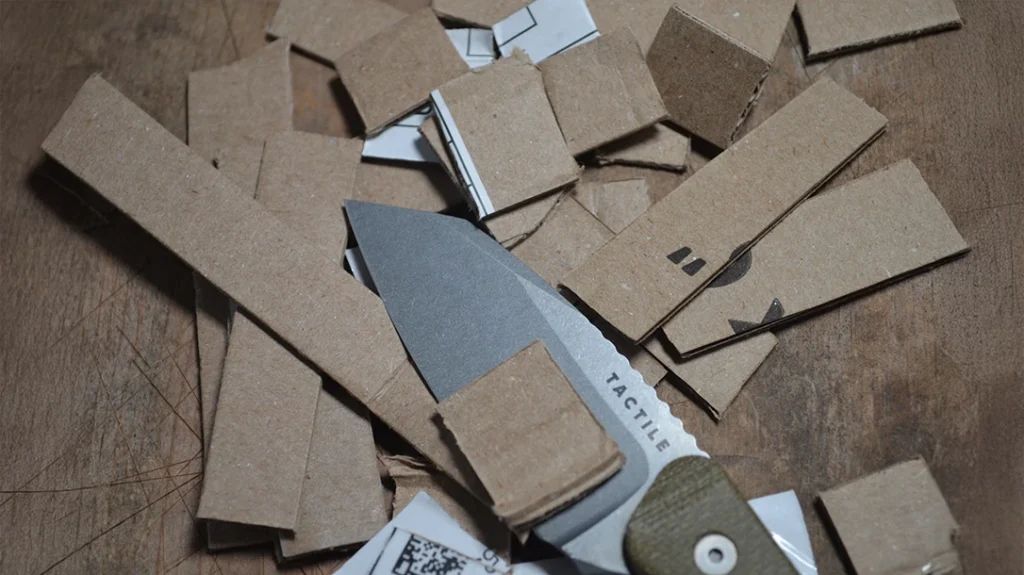
Next up was cardboard. Non-knife folks likely don’t realize just how nasty corrugated cardboard is for a blade’s edge. It’s filled with dust and dirt as well as hardened adhesives.
I started by making long, dragging cuts through the cardboard, mostly using the Redhawk’s point. It was like a hobby knife on steroids and made short work of the material. Then I took those strips and stood them on edge to slice through. This required a little sawing back and forth, as just push cuts weren’t getting it done. Not a deal breaker for me at all.
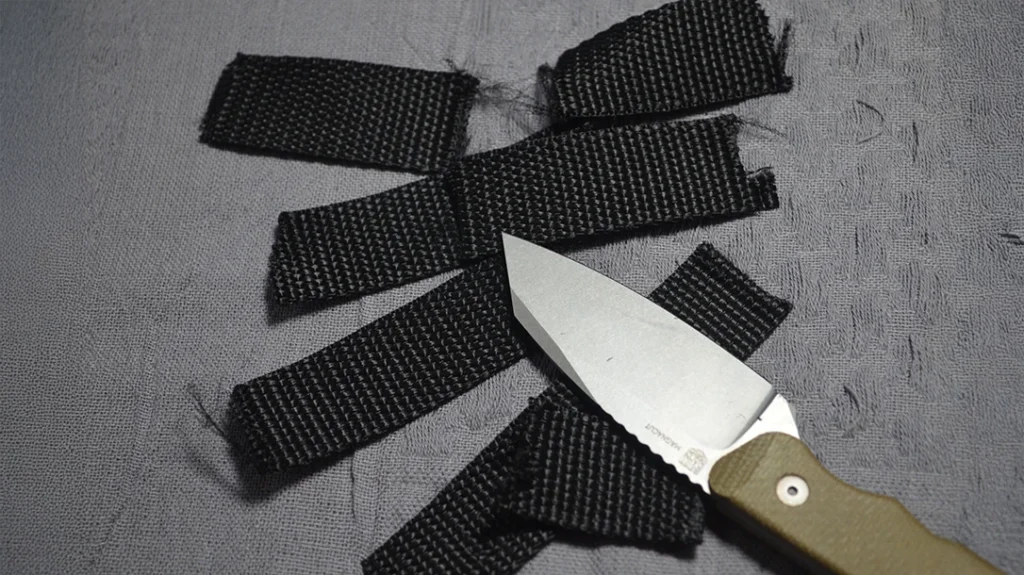
I recently purchased a roll of one-inch webbing for another project. So, I hacked off about two feet of it for testing the Redhawk. It did okay, but not quite as well as I’d hoped. Toward the end of the last couple of cuts, it was tearing the material more than slicing it. In the Redhawk’s defense, I’d not touched up the blade at all at any point from the time I received it.
All in all, I didn’t come across anything that took the Redhawk down a notch in my earlier estimation.
Who Needs a Redhawk?
In many ways, the Redhawk is the epitome of an EDC fixed blade. It’s practical, easy to carry, and comfortable to use. If you’re looking to add a fixed blade to your rotation, the Redhawk is definitely worth checking out.
I guess on the bright side, Taylor Martin saved me a bunch of work designing a knife.
Get the Tactile Knife Co. Redhawk at their website for $229. That’s for the base model shown in this review. If you want to upgrade to the green or black Cerakote models, those will run you $249 each.
Tactile Knife Redhawk Specs
| Overall Length | 6.9 inches |
| Blade Length | 2.75 inches |
| Steel | MagnaCut |
| Weight | 3.16 ounces |
| MSRP | $229 – $249 |