From lighting the cigarette of a damsel in distress to igniting gasoline and blowing up a horde of zombies, Zippo has been there. There’s a certain magic in that flick of the lid. Now, Zippo is throwing its hat in the ring with an axe, saw, and mallet in one tool—the AxeSaw. Let’s see how it fares!
The ZIPPO AxeSaw
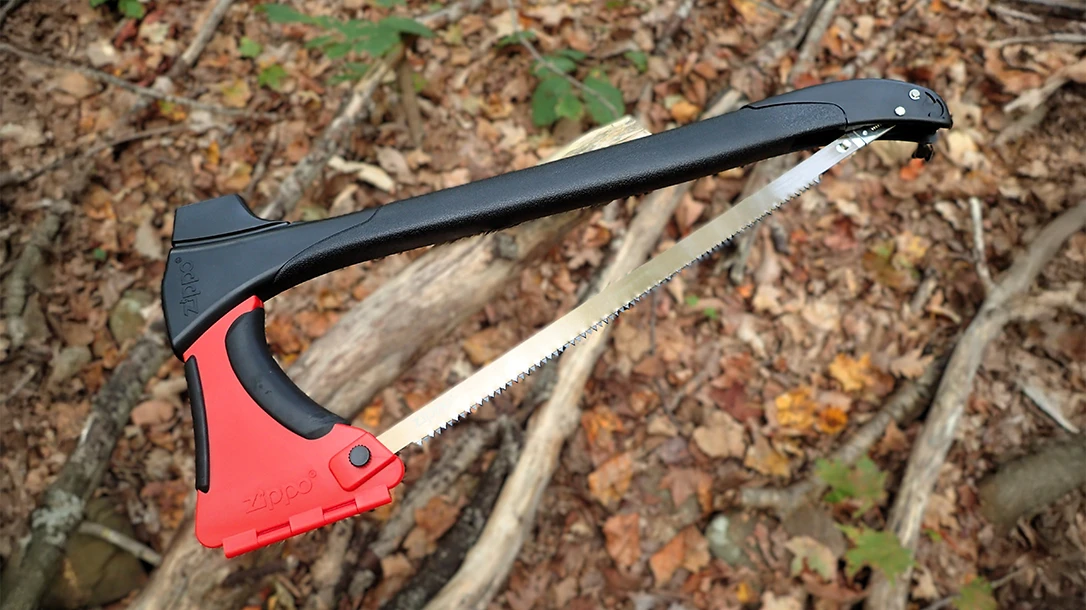
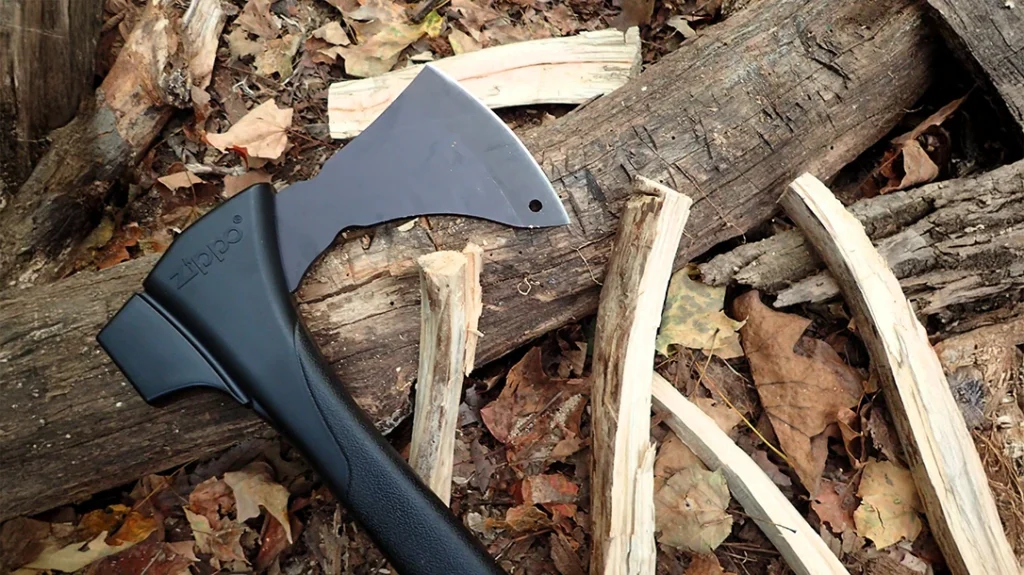
The Zippo AxeSaw is a triple-threat tool that chops, saws, and hammers without hogging pack space or weighing you down. It stands 8.6 inches tall and measures 20.3 inches in length. The total weight is just 2.6 pounds, making it light enough to swing, yet serious enough to split.
Advertisement — Continue Reading Below
The 5-inch axe head is made of 420 stainless steel, while the durable polymer handle conceals a 15-inch stainless steel saw blade (axe mode). Correspondingly, the saw blade cuts through logs up to 4 inches thick, or a bit more. Meanwhile, the safety sheath doubles as a non-slip saw handle with a built-in cam tensioner to keep things tight while sawing.
The axe head moonlights as a mallet, perfect for pounding tent stakes into stubborn ground. Shaving tinder, sawing, chopping, or setting up camp, the AxeSaw packs more punch per inch than your average multitool!
Not Your Grandpa’s Lighter
Zippo began in 1932 when George Blaisdell redesigned a clunky Austrian lighter into a sleek, one-handed windproof version. During World War II, Zippo halted consumer sales and supplied lighters exclusively to U.S. troops, cementing its reputation for ruggedness.
Advertisement — Continue Reading Below

Hollywood embraced Zippo, featuring it in over 2,000 films, including X-Men, I Love Lucy, and Hairspray – The Musical. Directors used Zippo to reflect character grit or evoke nostalgia with its iconic “click.”
In 2010, Zippo entered the outdoor market with a refillable metal hand warmer fueled by lighter fluid. The brand expanded with fire starters, utility lighters, and camping gear by 2013. Zippo continues to blend heritage, reliability, and pop culture into a global symbol of durability.
Advertisement — Continue Reading Below
Sawing with the AxeSaw
The AxeSaw comes out of the box ready for sawing. Its packaging includes some well-defined instructions and safety tips worth reviewing. I went directly for a dead maple with branches ranging from wrist-thick upwards.
I’m used to a 21 or 24-inch bucksaw. The smaller saw blade on the AxeSaw took some getting used to. However, it allowed me to use the entire length of the saw, as I usually do. The shorter length blade was also a stark reminder to stick to what it’s intended for—smaller branches.
Advertisement — Continue Reading Below
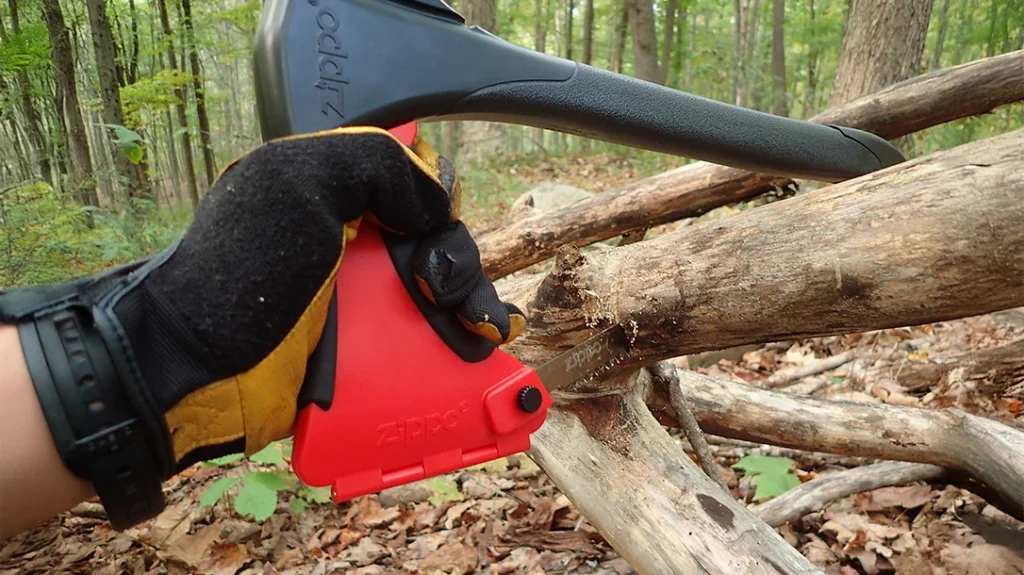
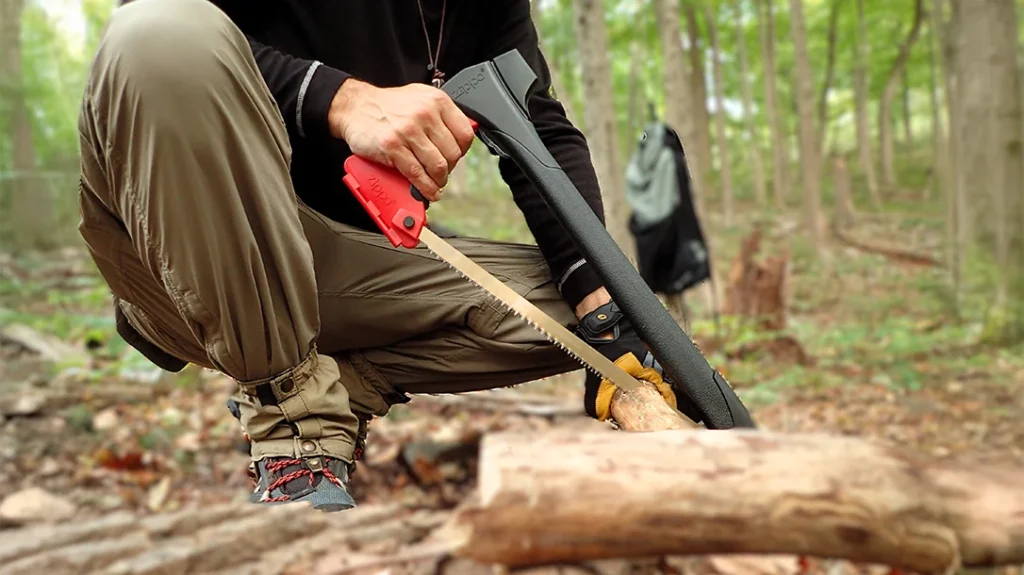
Proper saw use dictates reaching through the saw frame and grasping the wood to prevent the saw from biting my hand. This happens when it skips around searching for a home to bite into. The same applies to a small folding saw. Reaching over the blade to hold the wood is safer.
However, with the AxeSaw, there wasn’t room to go through, and it was too awkward to reach over. I wore gloves and found a secure hold with a knot or fork to shield my support hand. It was the next best option, and worked fine.
The axe handle with sheath gave me a secure, solid grip. Sawing vertically is what most of us do. However, sawing at a horizontal angle is challenging with a frame saw (bow or bucksaw).
Advertisement — Continue Reading Below
The size of the AxeSaw makes tight cuts manageable and not awkward. I employ a technique where I stand smaller wood vertically with my support hand. I saw the wood horizontally and moved both hands, pulling towards with the wood and away simultaneously.
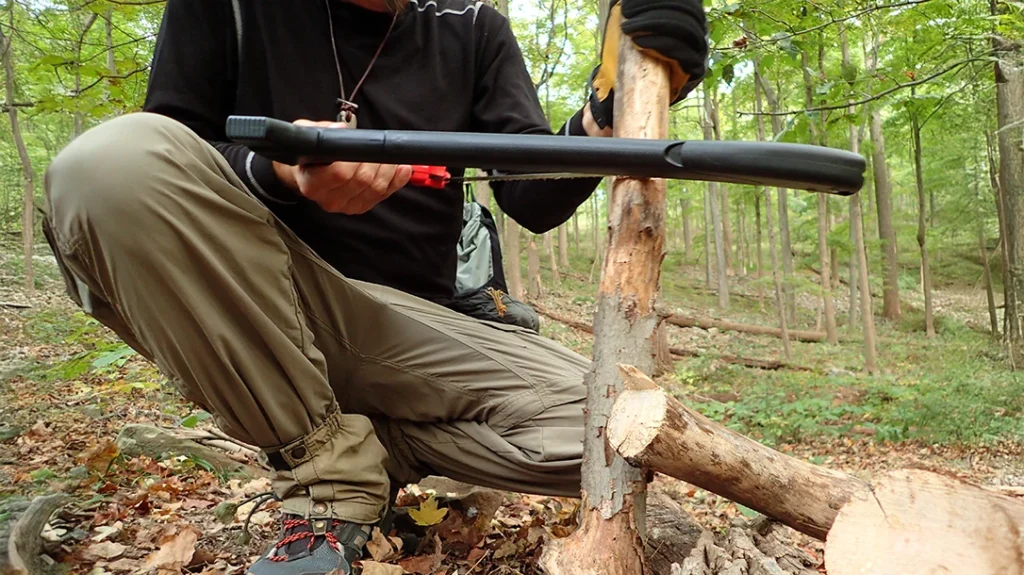
This method makes it easy to control small lengths of timber and saw efficiently and safely. The AxeSaw, with its shallower frame, made this a breeze on a humid summer day.
Advertisement — Continue Reading Below
Axe Mode
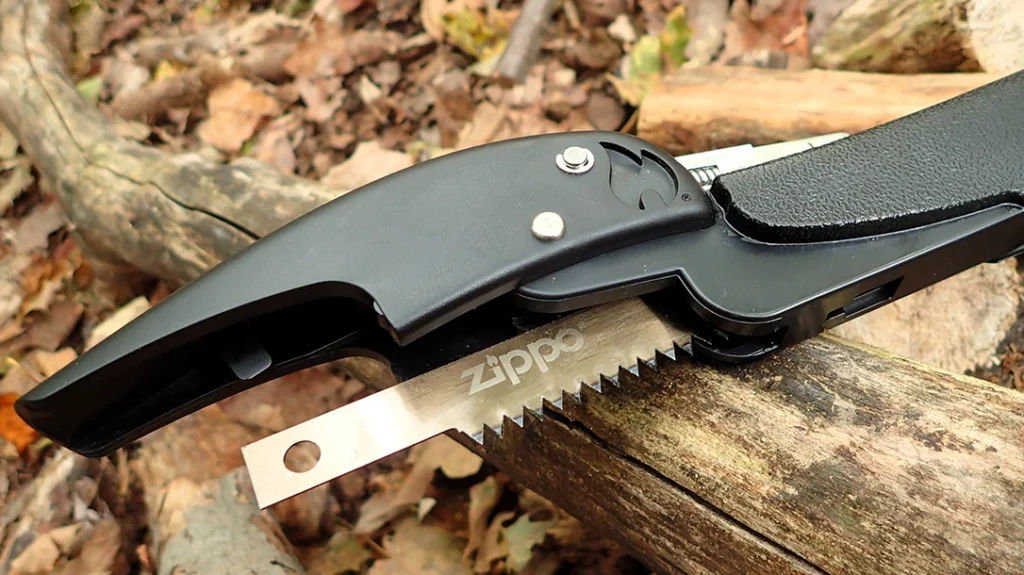
Switching to axe mode was simple. The cam and self-adjusting tensioner were smooth. The axe sheath has a set screw that opens and releases the saw blade and axe head. The axe handle houses the saw blade and closes to keep it secure. It rattles, but who cares? Once I started chopping, I never heard the rattle.
The axe blade sank deep into a large-diameter maple that had fallen about six months prior. It was way larger than anything I’d need to chop through. However, it was testing time!
Advertisement — Continue Reading Below
I started with 15-20 chops and evaluated it. All good. I continued until I was nearly half through the log. No edge issues or balance qualms. It felt good swinging, and having approximately 20 inches of length gave me lots of leverage.
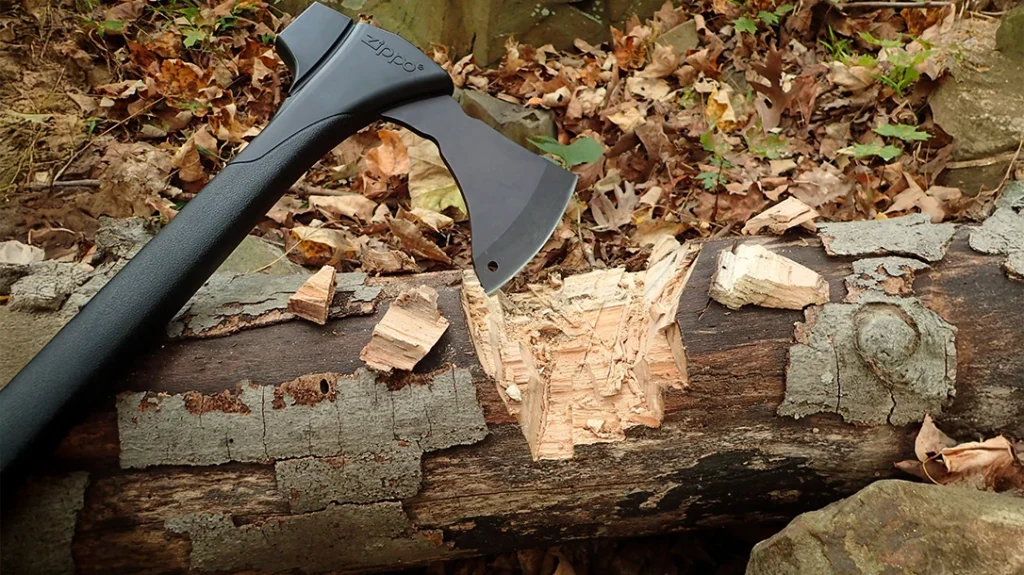
I chopped from a squatting and kneeling position for safety and to save my back. This position also adds a degree of protection. There was no way the heel or toe of the axe bit would get me due to the low position. Still, something about the cam lever distracted me, and having mental or physical distractions while chopping sucks!
Advertisement — Continue Reading Below
Splitting For Fire
You don’t need to split all wood. However, it’s a fact that split wood ignites faster and burns more efficiently than wide rounds. I split smaller, wrist-to-forearm cuts of wood about 6 inches tall, vertically on a wooden surface. This way is my least preferred way to split wood. But it worked.
Then, I performed some contact splitting, which the axe bit pulled off well. This method of bringing the axe blade and wood down together on a hard surface is safer and more controllable. I also split wood with a stout beater stick (baton) for even more control. Every method worked, despite the thin axe bit, which lacked the cheeks to wedge the wood. Bravo, Zippo!
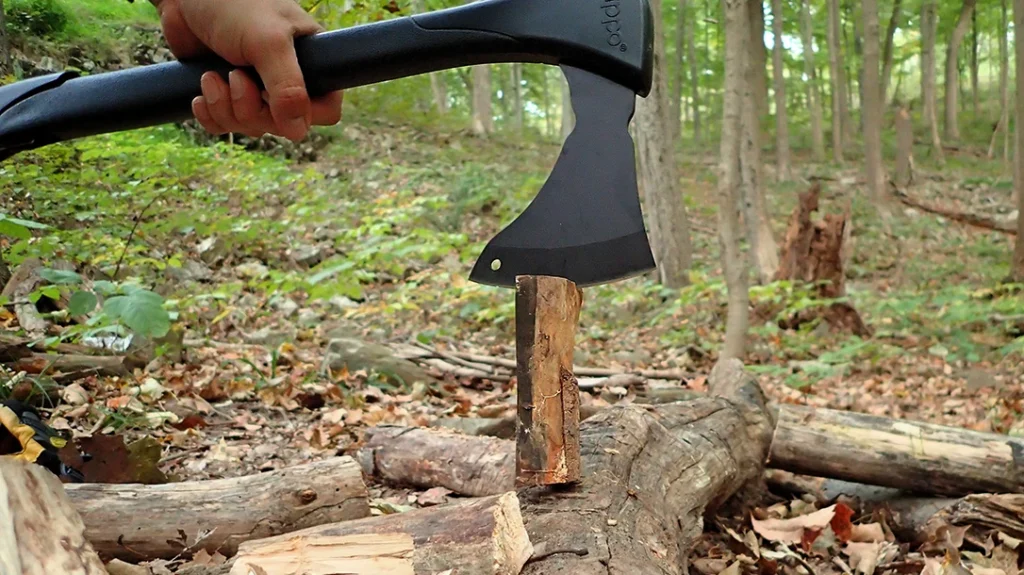
Trying to pull off every trick or technique with a tool is unnecessary. Stick to what the company designed it for and capitalize on its strengths. Simple is best, especially with so many moving parts on a tool.
The Handle
I found the polymer handle to have the right amount of grip and felt solid during chopping. The self-adjusting tension compensator ensures a tight fit for the saw blade during wood sawing. However, when in axe mode, the snap-down cam lever came loose and rattled a lot.
The part that comes in contact with the saw blade (in saw mode) was moving forward onto the axe grip. It was annoying and made me second-guess myself. I looked up several videos from Zippo and users for reference.
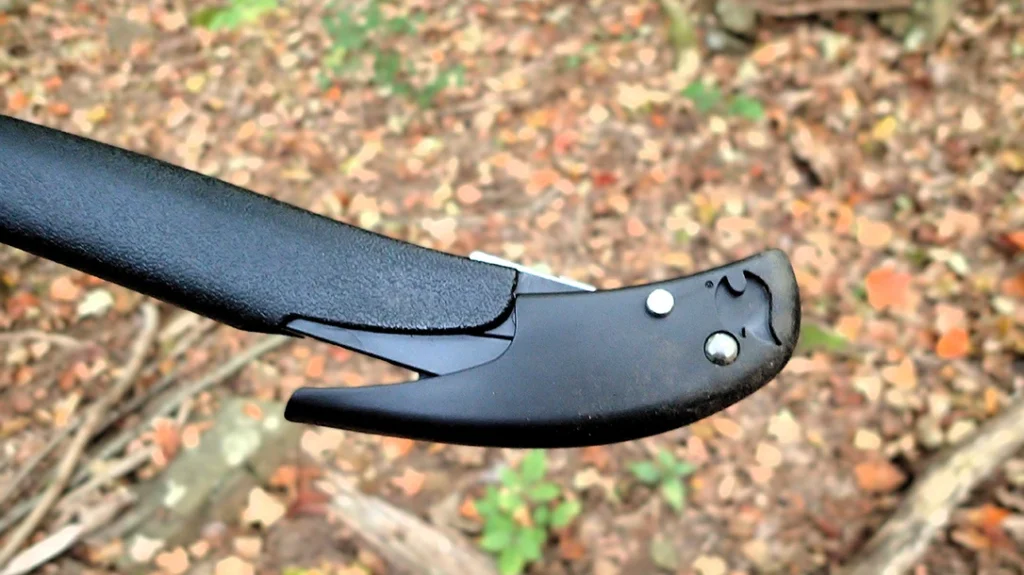
None of them showed any additional information or offered an alternative method for storing the saw in the handle. This means I did it right, and the metal cam lever is prone to interrupting the handle grip. All while swinging the axe. Not good!
The AxeSaw: Tackle Two Camp Chores in One Package
Perhaps most people don’t use their tools as much as others. Maybe the cam lever coming loose was only on mine? I hope Zippo can shed some light on this issue and remedy it.
If you want a tool that does two camp chores in one package, this may be it. Do the saw work first before converting it to axe mode. This way, there’s no need to change it back. Either way, it’s not hard to do so.
Zippo AxeSaw Specs
| Length | 20.3 inches |
| Axe Length | 5 inches |
| Axe Material | 420 stainless steel axe head |
| Handle Material | Polymer handle with saw blade storage |
| Saw Blade | 15-inch hardened stainless steel |
| Sheath | Dual Function saw handle & safety sheath (Red) |
| Saw Tension | Cam & self-adjusting tension compensation |
| Weight | 2.6 pounds |
| MSRP | $109.95 |
WHY OUR ARTICLES/REVIEWS DO NOT HAVE AFFILIATE LINKS
Affiliate links create a financial incentive for writers to promote certain products, which can lead to biased recommendations. This blurs the line between genuine advice and marketing, reducing trust in the content.